
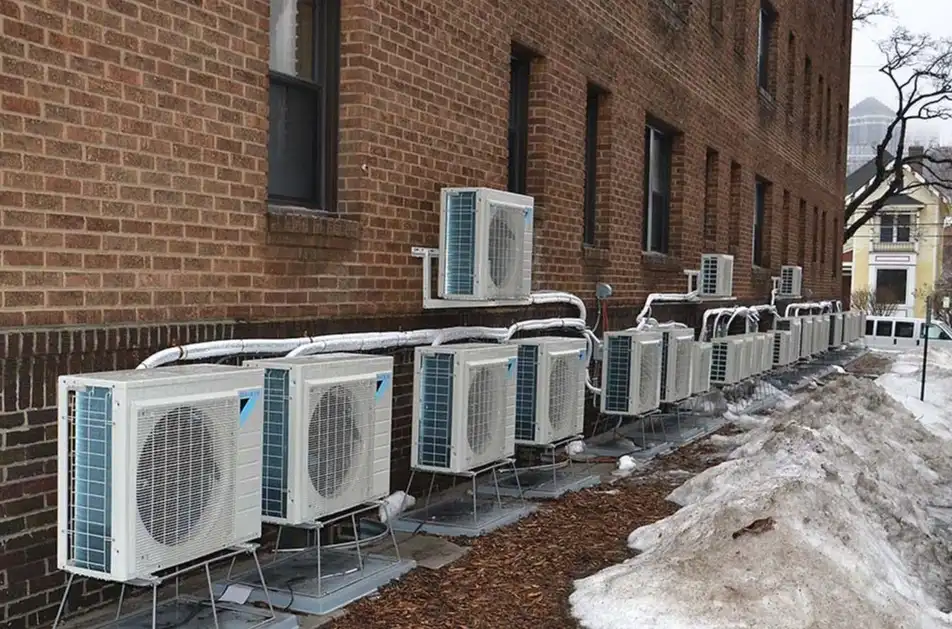
If you live in a pre-war apartment, brownstone, or historic townhouse in New York City, you already know the challenges of heating and cooling a building that was never designed for modern climate control. Original steam radiators that either blast tropical heat or leave you freezing. Window units that block your view and rattle all summer. A building without a single inch of ductwork anywhere.
Ductless mini-split systems have emerged as the go-to solution for these older NYC buildings — and for good reason. They deliver efficient heating and cooling without the invasive construction that central air would require.
This guide covers everything you need to know about mini-splits in older New York buildings: how they work, why they’re ideal for pre-war construction, what to expect during installation, and how to maximize value through rebates and incentives.
Why Older NYC Buildings Need a Different Approach
Most residential buildings in New York City were constructed before 1940. These pre-war buildings were designed in an era when heating meant coal-fired boilers and radiators, and air conditioning simply didn’t exist for residential use. The architecture reflects those realities.
What makes older NYC buildings challenging for HVAC:
-
No ductwork — and no space for it. Pre-war buildings have solid masonry walls, often with plaster applied directly to the interior brick. There’s no cavity for running ducts, and the construction is so sturdy that creating one would be enormously expensive and destructive.
-
High ceilings that complicate heating. Parlor floors and bedrooms often have 10-foot or higher ceilings. While elegant, high ceilings cause warm air to stratify at the top of the room — far above where you actually live.
-
Drafty construction. Gaps around original windows, old doors with transoms, and unsealed penetrations let cold air infiltrate and warm air escape. Even fireplaces that have been closed off can act as air leaks.
-
Unreliable existing heat. One-pipe steam systems — still common in brownstones — are notoriously difficult to balance. The parlor floor might be sweltering while upper floors stay cold.
Over 80% of large multifamily buildings in NYC still use steam heating systems. These systems often distribute heat unevenly, leaving some apartments overheated while others never reach comfortable temperatures.
Mini-splits solve these problems without requiring major structural changes — making them uniquely suited to the constraints of older New York buildings.
How Ductless Mini-Splits Work
A ductless mini-split system consists of two main components connected by refrigerant lines that pass through a small hole in an exterior wall — typically just 3 inches in diameter.
The outdoor unit (condenser/compressor):
-
Houses the compressor that pressurizes refrigerant
-
Releases heat to the outside air in cooling mode
-
Absorbs heat from outside air in heating mode
The indoor unit (air handler):
-
Mounts on an interior wall, ceiling, or floor
-
Blows conditioned air directly into the room
-
Contains the evaporator coil and filters
The connection:
-
Copper refrigerant lines (typically two, insulated together)
-
Electrical wiring and communication cable
-
Condensate drain line
Unlike traditional forced-air systems that push conditioned air through long duct runs — losing 20-30% of energy to leakage and thermal loss along the way — mini-splits deliver air directly from the indoor unit to your living space. No ducts, no energy loss.
Single-Zone vs. Multi-Zone Systems
Mini-splits come in two basic configurations, and choosing the right one depends on how many rooms you need to condition.
Single-Zone Systems
One outdoor unit connects to one indoor unit. This is the simplest and most affordable configuration — ideal for cooling a single large room or supplementing existing heating in one area.
Best for:
-
Studio apartments
-
Adding AC to a single bedroom or living room
-
Supplementing unreliable steam heat in one space
Typical cost (installed): $3,500–$6,000
Multi-Zone Systems
One outdoor unit connects to multiple indoor units — typically 2 to 5 zones. Each indoor unit operates independently with its own thermostat, allowing different temperatures in different rooms.
Best for:
-
Whole-apartment heating and cooling
-
Multi-floor brownstones
-
Apartments with irregular layouts or multiple exposures
Typical cost (installed): $10,000–$20,000+ depending on number of zones
Zone control is one of the biggest advantages of multi-zone mini-splits. You can cool the bedroom at night without cooling the empty living room. You can set the home office at 68°F while keeping the nursery at 72°F. Empty rooms don’t waste energy.
Cold-Climate Performance: Do Mini-Splits Work in NYC Winters?
This is the most common concern about mini-splits: can they actually heat a New York apartment when temperatures drop below freezing?
The short answer: yes, but you need the right equipment. Not all mini-splits are created equal when it comes to cold-weather performance.
Standard Mini-Splits
Basic models operate efficiently down to about 30°F and may struggle or shut off entirely when temperatures drop below 15-20°F. These are best suited for moderate climates or cooling-only applications.
Cold-Climate (Hyper-Heat) Mini-Splits
Premium cold-climate models from manufacturers like Mitsubishi (Hyper-Heating), Fujitsu (XLTH series), and Daikin (Aurora) are specifically engineered for freezing conditions. These units:
-
Operate efficiently at temperatures as low as -13°F to -15°F
-
Maintain close to full heating capacity even at 5°F
-
Include base pan heaters to prevent ice buildup in the outdoor unit
Some ultra-cold models from manufacturers like GREE now operate at temperatures as low as -31°F — far colder than NYC ever gets.
Key efficiency metric for heating:
Look for the HSPF (Heating Seasonal Performance Factor) rating. Higher is better. Cold-climate mini-splits typically achieve HSPF ratings of 10-12, compared to 8-9 for standard models.
Even at 5°F outside, a quality cold-climate heat pump can deliver a COP (Coefficient of Performance) of 2.5-3.0 — meaning it produces 2.5 to 3 units of heat for every unit of electricity consumed. That’s 250-300% efficiency, compared to 100% for electric resistance heat.
Indoor Unit Options: More Than Just Wall Mounts
While wall-mounted units are the most common — and often the most affordable — mini-splits offer several indoor unit styles to match different aesthetic and functional needs.
Wall-Mounted Units
The standard option. These mount high on an interior wall and blow conditioned air downward and outward into the room.
Advantages: Easiest installation, lowest cost, quiet operation (often under 30 decibels)
Drawbacks: Visible on the wall, some people find them unattractive
Ceiling Cassettes
Recessed into the ceiling with only a decorative grille visible — typically about 1 inch thick. Four-way cassettes distribute air in multiple directions for more even coverage.
Advantages: Nearly invisible, excellent air distribution for large open spaces
Drawbacks: Requires 9-12 inches of ceiling clearance, higher installation cost, more complex for pre-war buildings with solid plaster ceilings
Ceiling cassettes are popular in NYC renovations where aesthetics are a priority. Some co-op boards prefer them because they’re less visible from the street.
Floor-Mounted Units
Sit low on the wall near floor level, similar in appearance to a traditional radiator.
Advantages: Better for heating (warm air rises naturally), accessible filters, good for rooms with limited wall space
Drawbacks: Takes up floor space, may conflict with furniture placement
Concealed Ducted Units
A slim air handler hidden above a ceiling or in a closet, with short duct runs to discreet supply registers. This provides the “invisible” look of central air with the efficiency of a mini-split.
Advantages: Completely hidden, works well for multi-room coverage from a single unit
Drawbacks: Requires space for the air handler and duct runs, highest installation complexity
Installation in Older NYC Buildings: What to Expect
Installing a mini-split in a pre-war building involves unique challenges that experienced contractors understand. Here’s what the process typically looks like.
The Outdoor Unit Question
Every mini-split needs an outdoor condenser. In NYC apartments, finding a place for it is often the biggest obstacle.
Common placement options:
-
Rooftop: Common in brownstones and smaller buildings, but requires running refrigerant lines through multiple floors or up the building exterior
-
Balcony or terrace: Ideal when available, but check building rules about equipment on balconies
-
Rear yard or ground level: Possible for brownstone garden apartments
-
Building exterior wall: Often prohibited by co-op boards and landmark regulations
If placing the outdoor unit on the roof, the refrigerant lines may need to run through common areas or adjacent units — requiring additional coordination and potentially additional board approvals.
The Wall Penetration
Mini-splits require a hole through an exterior wall for the refrigerant lines, typically 2.5-3 inches in diameter. In pre-war buildings with solid masonry walls, this means drilling through brick — which is straightforward but requires proper sealing.
Some buildings — particularly those in historic districts or with landmark status — may not permit exterior penetrations. In these cases, through-window installation or ducted systems venting through a window become alternatives.
Electrical Requirements
Mini-splits require a dedicated electrical circuit. Single-zone systems typically need a 20-amp 120V or 230V circuit; larger multi-zone systems may require 30-amp 240V service.
In older buildings with limited electrical capacity, upgrading the panel or running new wiring may be necessary — and may require DOB permits.
Condensate Drainage
Mini-splits produce condensation that needs to drain somewhere. Wall-mounted units can often gravity-drain through the wall to the exterior. Ceiling cassettes require a condensate pump to lift water to a drain line.
Improper condensate handling leads to leaks, water damage, and mold — one of the most common mini-split problems and often a result of poor installation.
Timeline
A straightforward single-zone installation typically takes one day. Multi-zone systems may require two to three days. Add time for any necessary electrical work or complex line routing.
Building Approvals: Navigating Co-op and Condo Rules
If you live in a co-op or condo, your building’s board must approve your mini-split installation before work begins — regardless of how straightforward the project seems.
What boards typically require:
-
Architectural drawings showing equipment placement and line routing
-
Written scope of work
-
Contractor insurance certificates (liability and workers’ compensation)
-
Proof of appropriate licensing
-
Noise assessment for outdoor unit placement
Common building restrictions:
-
No exterior-mounted condensers on front-facing façades
-
Condensers must be placed on rooftops or rear-facing locations only
-
No visible refrigerant lines on building exterior
Board approval typically takes 2-4 weeks after submitting a complete package. In landmarked buildings, Landmarks Preservation Commission (LPC) approval may also be required — adding another 1-3 months.
Rebates and Incentives: Reducing Your Upfront Cost
New York offers some of the most generous heat pump incentives in the country. By combining federal tax credits, state rebates, and utility incentives, you can significantly reduce the cost of a mini-split installation.
Federal Tax Credit (25C)
The Inflation Reduction Act provides a federal tax credit of 30% of equipment and installation costs, up to $2,000 per year for heat pumps. This credit applies to qualified air-source heat pumps meeting efficiency requirements.
NYSERDA Clean Heat Rebates
New York State’s Clean Heat program offers rebates ranging from $1,000 to $3,000+ for whole-home heat pump installations, depending on equipment type and efficiency. Rebates are applied through participating contractors.
Utility Rebates (Con Edison)
Con Edison customers in NYC and Westchester may qualify for additional rebates of $2,000–$4,500 for qualifying heat pump systems. Specific neighborhoods in Brooklyn and Queens may qualify for enhanced incentives.
The residential rebate for mini-split heat pumps through Con Edison is typically $300 per unit, with an additional $135 available for adding a compatible smart thermostat. Enhanced rebates are available in certain neighborhoods.
Total Potential Savings
By stacking federal tax credits, NYSERDA rebates, and utility incentives, homeowners can potentially reduce the net cost of a heat pump installation by $5,000–$9,500 or more.
For income-qualified households, NYSERDA’s EmPower+ program may cover the full cost of heat pump installation — up to $10,000 per project.
Mini-Splits vs. Keeping Your Steam Radiators
If your building has steam heat, you may wonder whether to replace it entirely with mini-splits or use the new system as a supplement.
Using Mini-Splits as Primary Heat
Cold-climate mini-splits can absolutely serve as the primary heat source in a well-insulated home. They’re more efficient than steam, offer precise temperature control, and eliminate the uneven heating that plagues one-pipe steam systems.
However, there are important considerations:
-
You’re still paying for building heat through maintenance fees whether you use it or not
-
Electricity costs may exceed your share of building heating costs in the coldest months
-
If mini-splits fail during extreme cold, having backup heat available is wise
Using Mini-Splits as Supplemental Heat
Many brownstone owners take a hybrid approach: they keep the radiator system running but use mini-splits to boost heat in specific rooms, provide cooling in summer, and smooth out the temperature swings that steam systems create.
This approach lets you enjoy the benefits of mini-split comfort while keeping the reliable steam heat as backup during the coldest stretches of winter.
Energy Efficiency and Operating Costs
Mini-splits are among the most efficient heating and cooling systems available — far more efficient than window units, PTACs, or electric baseboard heat.
Efficiency ratings to look for:
-
SEER (cooling): Premium units achieve SEER 20-22. Higher SEER means lower cooling costs.
-
HSPF (heating): Cold-climate units reach HSPF 10-12. Higher HSPF means lower heating costs.
-
Inverter technology: All quality mini-splits use inverter-driven compressors that modulate output to match demand, rather than cycling fully on and off.
Compared to window units, mini-splits are typically 30-40% more efficient for cooling. Compared to electric resistance heat, they’re 200-300% more efficient for heating — using 2-3 times less electricity to produce the same warmth.
Because mini-splits deliver air directly to your space without ductwork, you also avoid the 20-30% energy loss that occurs in typical ducted systems from leaky or poorly insulated ducts.
Noise: What to Expect
One of the biggest benefits of mini-splits over window units is dramatically quieter operation.
Typical noise levels:
-
Window AC: 50-60 decibels (comparable to normal conversation)
-
Wall-mounted mini-split indoor unit: 19-32 decibels (whisper to quiet library)
-
Outdoor condenser: 50-60 decibels at full output
At lower outputs — which inverter-driven units run at most of the time — indoor units are essentially inaudible. Many people describe them as producing just a gentle whisper of moving air.
Outdoor unit noise matters for neighbor relations, especially in dense NYC buildings. Placing the condenser away from bedroom windows (yours and your neighbors’) and using vibration isolation mounts reduces disturbance.
Maintenance Requirements
Mini-splits require minimal maintenance, but neglecting basic upkeep leads to reduced efficiency, poor air quality, and shortened equipment life.
Homeowner tasks (monthly):
-
Clean or replace air filters — most mini-splits have washable filters that slide out easily
-
Check that nothing is blocking airflow around indoor and outdoor units
Professional service (annually):
-
Deep clean of indoor coil and blower
-
Check refrigerant levels and connections
-
Inspect and clean outdoor unit coils
Annual professional maintenance typically costs $100-$300 and helps ensure efficient operation and catch small problems before they become expensive repairs.
Final Thoughts
For owners of pre-war apartments, brownstones, and historic NYC buildings, ductless mini-splits solve a problem that has frustrated New Yorkers for generations: how to achieve modern climate control in buildings never designed for it.
They deliver efficient heating and cooling without destroying original architectural details, invasive construction, or the compromises of window units. With proper sizing and professional installation, they provide comfort that rivals any new construction — in buildings a century old.
The key is choosing cold-climate equipment rated for New York winters, working with a contractor who understands the unique challenges of older buildings, and taking advantage of the generous rebates available to reduce upfront costs.
🏠 Modern comfort meets classic New York architecture — no ducts required.